Origin
The manual that reads like your last meeting
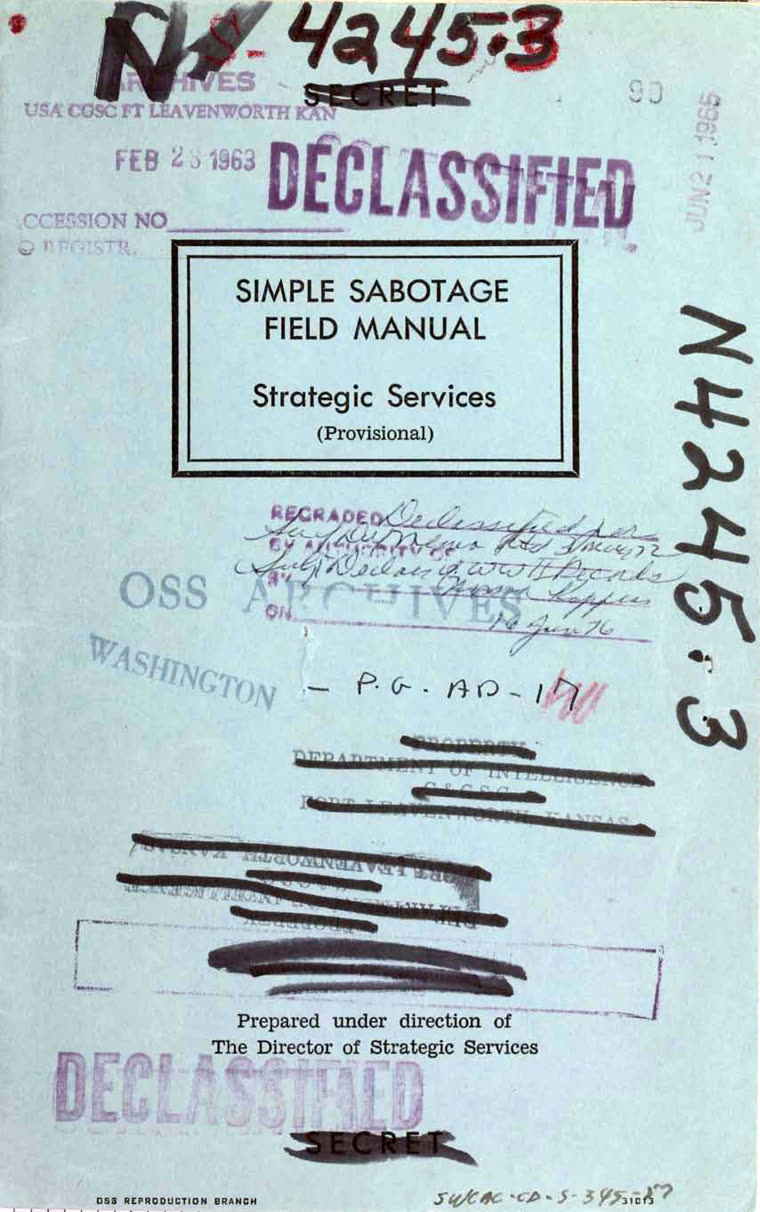
In January 1944, the OSS — the wartime predecessor of the CIA — published the Simple Sabotage Field Manual. It taught ordinary citizens in occupied Europe how to quietly damage their own workplaces. Most of it deals with machinery and transport. But one section stands apart: General Interference with Organizations and Production — sabotage carried out not with tools, but in meetings.
Its advice, verbatim
- Insist on doing everything through channels. Never permit short-cuts.
- Talk as frequently as possible and at great length.
- When possible, refer all matters to committees, for "further study and consideration."
- Bring up irrelevant issues as frequently as possible.
- Haggle over precise wordings of communications, minutes, resolutions.
- Refer back to matters decided upon at the last meeting and attempt to re-open the question of the advisability of that decision.
- Advocate "caution." Urge fellow-conferees to avoid haste which might result in embarrassments or difficulties later on.
The manual was declassified in 2008, and everyone who reads it has the same reaction: this describes meetings I've been in. Meetings nobody was sabotaging.
That reaction is the point — and it's why Rapora exists.
Almost no one is a saboteur. But under fear, fatigue, unclear ownership, or misaligned incentives, ordinary people drift into exactly these behaviours — invisibly, unintentionally, and at real cost to their teams. The OSS didn't invent them; it catalogued what already destroys organisations from the inside, and weaponised it.
Rapora detects the patterns, never the intent. It can tell you what happened in a meeting — that a decision was deferred for the fourth time, that "good progress" was reported where none is visible. Only a human who knows the team can tell you why, and what to do about it. That's why Rapora is an instrument for professionals — consultants and coaches who read a finding as the start of a conversation, not the end of one.
If you're looking for a tool to catch saboteurs, this isn't it — by design. If you're looking for a mirror your teams can actually look into, welcome.
See the ethics we built in
Consent, always. Team dynamics, not individual assessment. Local by architecture, not by policy.
Read the ethics →